0.00 verified reviews·14 days·Moderate to Challenging
Annapurna Circuit Trek
Annapurna Circuit Trek
Annapurna Circuit Trek
Photography: Sergey Ashmarin, Solundir (CC BY-SA 3.0), via Wikimedia Commons
DURATION
14 days
HIGHEST POINT
Thorong La Pass (5,416m)
DIFFICULTY
Moderate to Challenging
GROUP SIZE
2–10 Trekkers
BEST SEASONS
Spring & Autumn
28 years guiding the Nepal Himalaya
·
100% NMA-certified guides
·
Small groups, max 12
·
Reserve free — no card needed
Through the Heart of the Himalayas with- Himalayan trekkers choice
“NOT ALL WHO WANDERS ARE LOST”- J.R.R TOLKIEN.
Some journeys begin with airports and itineraries.
The Annapurna Circuit begins with cold mountain air, the smell of tea house firewood, and the sudden realization that your legs may have signed up for something your lungs did not fully agree to.
Somewhere beyond the busy streets of Kathmandu and the peaceful lakeside mornings of Pokhara, the trail slowly disappears into the Marsyangdi Valley — where waterfalls crash through deep forests, suspension bridges swing above turquoise glacial rivers, and prayer flags dance like they own the wind. And honestly, up there, they probably do.
The Annapurna Circuit is not simply a trek through Nepal. It is a gradual journey through changing worlds. Over 14 unforgettable days, the landscape transforms from lush subtropical hills into the raw Himalayan wilderness of MANANG, THORONG LA PASS, and the windswept KALI GANDAKI GORGE. One moment you are walking through pine forests beside mule caravans; the next you are standing in alpine deserts beneath glaciers older than human memory.
Places where life still moves with the rhythm of mountains, weather, and prayer. Elderly women spin prayer wheels beneath mani walls while trekkers awkwardly attempt to look “casually adventurous” for photos after climbing 1,000 meters before breakfast.
At TravelNepal.Asia, we believe the best Himalayan experiences are not rushed. The Annapurna Circuit is designed around acclimatization, connection, and the slow emotional rhythm of mountain life. Tea houses become temporary homes. Strangers become trail family. Dal-Bhat somehow becomes the greatest meal you have ever eaten — twice a day, every day, and somehow you still crave it afterward.
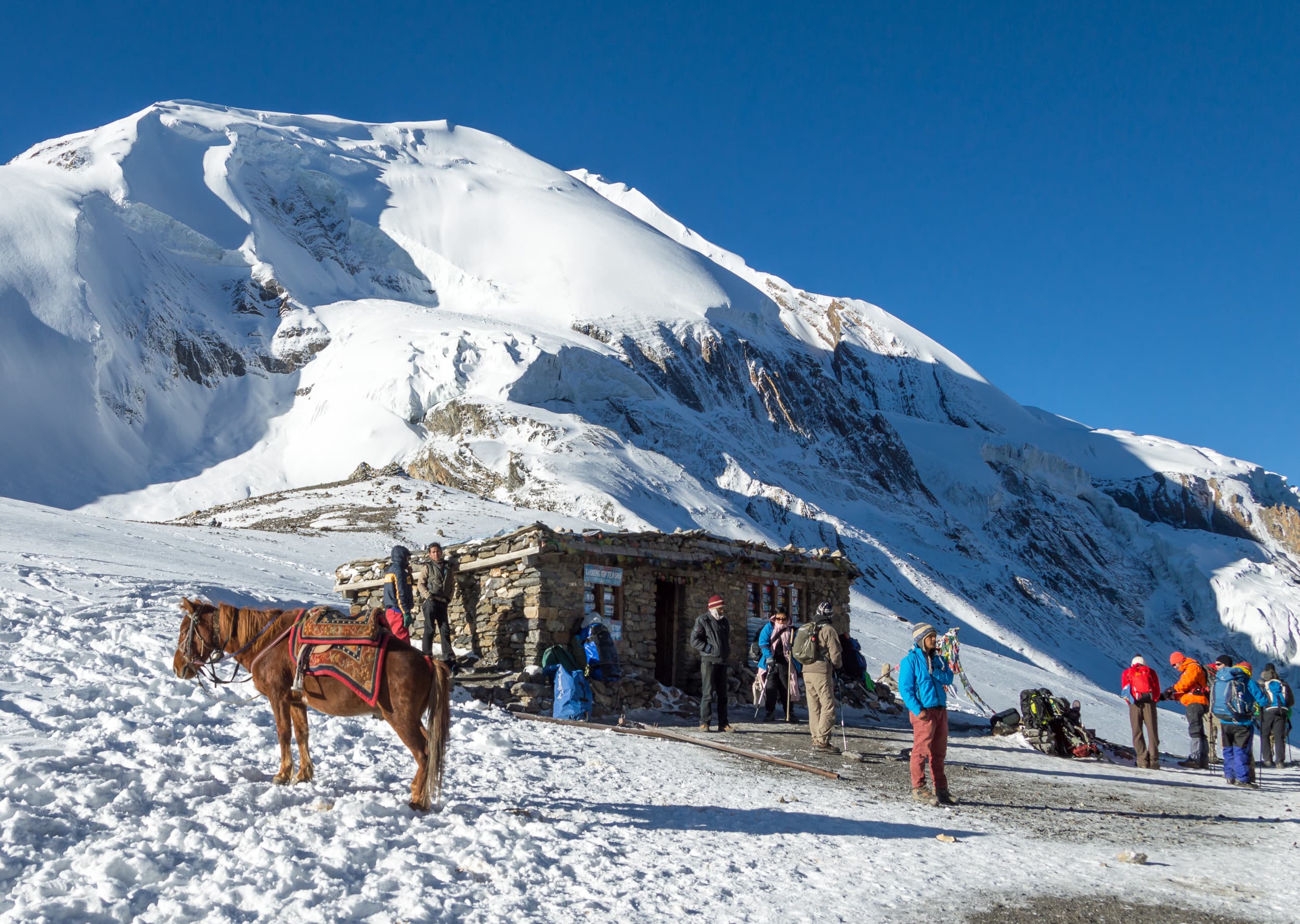
The highest point of the journey is the legendary-THORONG LA PASS(5,416m). The climb begins before sunrise, under a sky full of stars and life decisions. Every step feels heavier. Every breath feels expensive. But standing at the top, surrounded by snow peaks, prayer flags, and complete Himalayan silence, something shifts inside you.
Not dramatically.
Quietly.
The mountains have a strange way of simplifying people.
Beyond the pass, the trail descends toward the sacred landscapes of Muktinath and through the KALI GANDAKI GORGE— the deepest gorge on Earth — where dry Tibetan-style valleys, ancient monasteries, and wind-carved cliffs create one of the most cinematic landscapes in the Himalayas.
The Annapurna Circuit is challenging, beautiful, humbling, and unexpectedly emotional.
You come for the mountains.
You stay for the feeling.
And somehow, long after the trek ends, part of you never really leaves.
This is not just a trek-This is a complete Himalayan life experience.
WHAT YOU GET
Trek highlights
Cross the Legendary Thorong La Pass (5,416m)One of the world’s highest trekking passes — where every breath feels earned and every photo feels heroic.
Experience Ever-Changing LandscapesWalk from lush forests and waterfalls to dramatic Himalayan deserts within a single journey.
Explore Ancient Himalayan VillagesDiscover traditional Gurung, Manangi, and Tibetan-influenced communities rich in culture and hospitality.
Immerse Yourself in Buddhist Mountain CultureSpin prayer wheels, pass ancient monasteries, mani walls, and colorful prayer flags fluttering in the wind.
Witness Jaw-Dropping Mountain ViewsEnjoy panoramic vistas of Annapurna, Dhaulagiri, Manaslu, Tilicho Peak, Gangapurna, and more.
Walk the Historic Nepal–Tibet Trade RouteTrek through trails once used by traders carrying salt, wool, and herbs across the Himalayas.
Taste the Legendary Dal Bhat PowerThe official fuel of trekkers, guides, and somehow every superhuman porter in Nepal.
Enjoy Cozy Tea Houses & Mountain BakeriesWarm meals, hot tea, apple pie, and unforgettable mountain evenings after long trekking days.
Experience Magical Himalayan NightsBright stars, peaceful silence, cold mountain air, and occasional yak traffic outside your window.
Challenge Yourself Beyond ComfortThe Annapurna Circuit is not just a trek — it’s a journey of adventure, resilience, culture, and lifelong memories.
THE TRAIL
Altitude profile
The altitude reached each day, taken from the itinerary. The acclimatisation days are the flat stretches — they are what make the high days safe.
ALTITUDE PROFILE
Jagat → Jomsom · high point Thorong La Pass (5,416m)
Hover a point for that day
Altitude table
Day 0 · Arrival in Kathmandu1,400 m
Day 1 · Jagat1,300 m
Day 2 · Dharapani1,860 m
Day 3 · Chame2,670 m
Day 4 · Upper Pisang3,300 m
Day 5 · Manang3,540 m
Day 6 · Acclimatise · Manang3,540 m
Day 7 · Yak Kharka4,050 m
Day 8 · Thorong Phedi4,540 m
Day 9 · Muktinath5,416 m
Day 10 · Buffer day3,800 m
Day 11 · Jomsom2,743 m
Day 12 · Pokhara822 m
Day 13 · Kathmandu1,400 m
Day 14 · Departure1,400 m
DAY BY DAY
Detailed itinerary
15 days · tap any day for the full detail
0
Welcome to Nepal — where the mountains are high, the smiles are warm, and the traffic follows spiritual guidance more than road rules.
After arriving in Kathmandu, our team will transfer you to the hotel in Thamel, the colorful heart of the trekking world. The rest of the day is free for relaxing, exploring tiny streets, gear shopping, or enjoying your first proper Nepali tea.
In the evening, we gather for a short trek briefing where we discuss the route, altitude, weather, safety, and answer all important mountain questions — including whether carrying extra snacks is considered essential equipment. (It is.)
Overnight stay in Kathmandu.
1
Early in the morning, we leave Kathmandu behind and begin driving toward the Annapurna region.
The road follows rivers, waterfalls, terraced farms, and hillside villages that somehow balance perfectly on steep mountains. After Besishahar, the smooth roads slowly disappear and the adventure officially begins — welcome to Himalayan off-roading.
The deeper we drive, the bigger the valleys become and the fresher the air feels. By evening, we arrive in Jagat beside the roaring Marsyangdi River.
Tonight, the mountains feel close.
Tomorrow, we finally walk into them.
2
After breakfast, we begin our first proper trekking day through waterfalls, river valleys, and beautiful villages like Tal.
The trail constantly moves between rocky paths, suspension bridges, and endless stone staircases — the Himalayas’ polite way of testing your confidence early.
Along the way, we pass mule caravans carrying supplies to remote villages. They always seem relaxed while trekkers negotiate with gravity and backpacks.
By afternoon, we arrive in Dharapani where Tibetan culture, prayer flags, and cooler mountain air welcome us properly into the Himalayas.
Hot tea has never felt more deserved.
3
Today the mountains begin showing their true scale.
We walk through pine forests, cross rivers on swinging bridges, and pass traditional villages where life moves peacefully at mountain pace.
Near Timang village, Annapurna II suddenly appears above the valley like a giant wall of snow and ice. Most trekkers stop here — partly for photos, partly because the mountain quietly steals everyone’s attention.
By evening, we reach Chame, surrounded by forests and snowy peaks. If energy allows, there’s even an optional natural hot spring nearby for tired legs and dramatic mountain storytelling.
4
Today feels cinematic from the very beginning.
The valley suddenly widens while enormous cliffs and snowy peaks rise on every side. We pass beneath the massive Paungda Danda rock face and follow trails through alpine forests and suspension bridges above glacial rivers.
The air grows thinner today, so we slow the pace and let the mountains set the rhythm.
By sunset, Upper Pisang rewards us with unforgettable Himalayan views and skies full of prayer flags dancing in the wind.
5
Today we take the famous upper trail through Ngawal — harder than the lower route, but worth every uphill step.
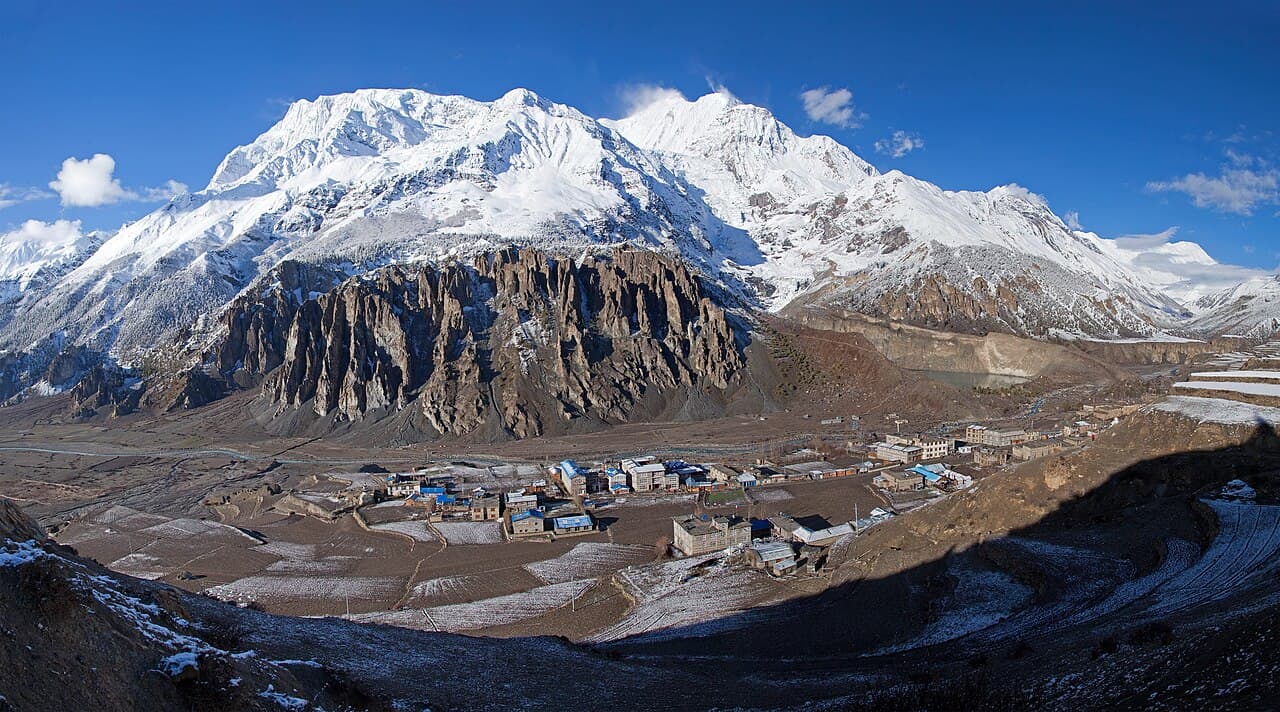
The views stretch endlessly across Annapurna III, Gangapurna, Tilicho Peak, and the entire Manang Valley. Stone villages, spinning prayer wheels, and grazing yaks make the landscape feel almost unreal.
By now, altitude begins joining the conversation.
Everyone walks slower.
Everyone breathes louder.
And somehow, everyone laughs more too.
We descend gently into Manang by afternoon — one of the most iconic mountain villages in Nepal.
6
Today is important for letting the body adjust to altitude before heading higher.
We spend the day exploring around Manang with optional hikes to Ice Lake, Gangapurna Glacier, or nearby monasteries. The rule today is simple:
walk high, sleep low, drink lots of water.
Your guide will probably remind you to hydrate at least twenty times today.
That’s not enthusiasm.
That’s survival strategy.
7
Trees slowly disappear today as the landscape becomes dry, open, and beautifully rugged.
The trail climbs steadily through yak pastures and rocky hillsides beneath giant Himalayan peaks. At this altitude, even small hills begin feeling strangely personal.
Yak Kharka appears quietly in the middle of wide mountain silence — just a few teahouses, grazing yaks, and endless sky.
8
Today is shorter but tougher because the altitude begins reminding everyone who is actually in charge.
The trail crosses rocky slopes and landslide sections before reaching Thorong Phedi — the final stop before crossing Thorong La Pass.
Tonight feels different.
Backpacks are packed carefully.
Headlamps are checked twice.
And everyone suddenly becomes very serious about sleeping early.
Tomorrow is the day we cross the Himalayas.
9
Wake-up time today is somewhere between “early morning” and “questionable life decisions.”
Under headlamp light, we begin the slow climb toward Thorong La Pass beneath freezing Himalayan skies.
Step by step, breath by breath, we climb higher until finally colorful prayer flags appear through the cold mountain wind.
Thorong La Pass.
5,416 meters.
One of the highest trekking passes in the world.
There are hugs, photos, exhausted smiles, and heavy breathing shared equally by everyone.
After celebrating at the top, we begin the long descent into Mustang toward the sacred pilgrimage town of Muktinath.
The hardest day of the trek.
And usually everyone’s favorite.
10
The Himalayas are beautiful — and wonderfully unpredictable.
This extra day is kept as a buffer in case of bad weather, altitude adjustment, flight delays, or simply needing extra rest after crossing Thorong La Pass.
If everything goes smoothly, the day becomes a bonus opportunity to relax, explore nearby villages, enjoy local culture, or simply let tired legs recover properly.
And honestly, in the mountains, having an extra day is never a bad idea.
11
The landscape changes completely today.
Green forests disappear behind us as we enter the dry and dramatic Mustang region. We follow the Kali Gandaki River through ancient villages like Kagbeni while powerful valley winds accompany us toward Jomsom.
At some point today, the wind will absolutely try stealing someone’s hat.
The mountains enjoy small entertainment too.
12
An early morning flight or drive takes us back to Pokhara.
After days in the mountains, Pokhara suddenly feels luxurious:
hot showers,
comfortable beds,
fresh coffee,
and WiFi that mostly remembers how to work.
The evening is free to relax beside Phewa Lake and celebrate the adventure together.
13
Today we return to Kathmandu through scenic river valleys and rolling hills.
The mountains slowly fade behind us, but the stories somehow become bigger with every hour.
Tonight is for celebration, good food, shared memories, and realizing how quickly strangers became trekking family.
14
Today marks the end of the Annapurna Circuit journey.
As we say goodbye at the airport, one thing becomes clear:
the trek may officially end here —
but a part of the Himalayas quietly travels home with everyone.
Congratulations — you officially survived the Annapurna Circuit.
Your legs may disagree for a few more days, but your heart probably already wants another trek.
Over the past two weeks, you crossed rivers, climbed mountains, shared tea with strangers who became family, and stood above 5,000 meters where breathing itself felt like an achievement. Somewhere between the prayer flags, yak bells, garlic soup, and endless staircases, the mountains quietly changed something inside all of us.
The Himalayas have a funny way of humbling people.
They remind us to slow down, laugh more, appreciate simple things, and respect every small step forward.
Thank you for allowing us to walk this journey with you. Your energy, stories, patience, and smiles became part of this adventure too.
And remember:
You are now officially allowed to say,
“Back in the Himalayas…” during random conversations for the rest of your life.
Until the mountains call again —
Namaste, safe travels, and see you on the next trail.
Annapurna Circuit 35 Profit Pricing Model Itinerary Based
The Himalaya is unpredictable and we plan for it. Client safety comes before the summit, every time — no guest is pushed higher with dangerous symptoms.
Our priority is always:
Client Safety Before Summit
Guides continuously monitor:
·Altitude symptoms
·Weather conditions
·Trekking pace
·Oxygen levels
·Overall group condition
·Slow the pace
·Increase hydration & rest
·Monitor oxygen saturation
·Add acclimatization time if needed
No guest is pushed higher with dangerous AMS symptoms.
·Immediately descend
·Stop further ascent
·Arrange emergency evacuation if required
·Coordinate medical support
·Severe AMS / HAPE / HACE
·Serious injury
·Breathing difficulties
·Medical emergencies
·Stabilize the client
·Contact rescue teams immediately
·Arrange helicopter evacuation
·Assist with insurance coordination
·Transfer to Kathmandu hospital if required
·Rebook the earliest available flight
·Adjust itinerary if possible
·Arrange extra accommodation support
·Provide continuous updates
·Shared helicopter arrangements
·Ramechhap flight rerouting
·Flexible scheduling support
Safety decisions are always final in the mountains.
·Heavy snowfall
·Storms
·Unsafe trails
·Avalanche risk
·Delay departures
·Modify route plans
·Add extra rest days
·Turn back if conditions become unsafe
Every group carries:
Nearest medical support:
·First aid kit
·Oximeter
·Basic emergency medication
·Emergency communication support
·Namche Bazaar
·Pheriche Aid Post
·Kathmandu hospitals
We strongly discourage:
·Slow acclimatization pacing
·Daily health monitoring
·Hydration reminders
·Group movement management
·Alcohol at altitude
·Rapid ascent
·Trekking alone
·Ignoring symptoms
Healthy staff create safer expedition
·Fair wages
·Insurance coverage
·Proper equipment support
·Safe load limits
CHOOSE YOUR LEVEL
Packages
Every package walks the same trail with the same licensed guides. What changes is the standard of hotels, transport and support around it. Prices are per person and fall as the group grows.
Larger groups reduce the guide cost per person, share transportation, spread porter allocation, and lower operational overhead and admin costs. A solo trek still requires a full guide setup, operational support, permit handling and emergency coordination — which is why solo prices remain significantly higher.
The Himalayas are unpredictable, and we take that seriously. From altitude monitoring and weather-based itinerary adjustments to emergency evacuation coordination and backup transportation plans, your safety is always our highest priority. We don’t just guide treks — we prepare for the unexpected before it happens.
️ Authentic Himalayan Experience
We don’t just organize treks — we share the mountains, culture, stories, and local lifestyle that we grew up with.
Experienced & Professional Mountain Guides
Our guides are government-licensed, highly experienced, and trained to handle high-altitude trekking with safety, confidence, and care.
Safety Comes First
We prioritize proper acclimatization, daily health monitoring, oxygen saturation checks (oximeter), and responsible pacing throughout the trek.
☕ Friendly & Human Guiding Style
We guide like real people — supportive, flexible, humorous, and understanding. Sometimes a good laugh is just as important as a good rest stop
Fresh & Hygienic Meals Included
Enjoy warm breakfasts, lunches, dinners, and tea every day with carefully selected tea houses serving reliable and energy-filled mountain meals.
️ Comfortable Tea House Accommodation
We choose clean and comfortable tea houses with the best available facilities to help you rest properly after long trekking days.
Small Groups, Better Experience
Smaller groups allow us to give more personal attention, flexible pacing, and a more meaningful trekking experience for everyone.
Reliable Porter Support
Our hardworking porters help carry your heavy luggage so you can enjoy the journey with more comfort and energy.
Local Knowledge Beyond Guidebooks
From hidden viewpoints to local traditions and village stories, we help you experience the Himalayas beyond the typical tourist route.
Clear Communication & Honest Support
We provide fast replies, honest advice, and organized support before and during your trek to make everything stress-free and smooth.
Well-Managed Logistics & Transportation
From airport pickup to mountain transportation and accommodation coordination, we handle the details so you can focus on the adventure.
❤️ Personalized Care Throughout the Journey
We genuinely care about your experience, comfort, safety, and memories from the moment you arrive until your departure.
More Than a Trek — A Memory for Life
The mountains are beautiful, but the connections, laughter, challenges, and shared moments are what truly make the journey unforgettable.
Passionately Operated by Mountain People
Trekking isn’t just business for us — it’s part of our identity, culture, and way of life.